

The Strain Calculator is a simple tool used to calculate the strain (ε) of a material when you know its original length (L₀) and the final length (L) after deformation. Strain is a measure of the deformation experienced by a material relative to its original size. It is expressed as a dimensionless ratio.
Strain Calculator – Instantly Compute Engineering Strain from Length Changes
Our team converts drinks into code — fuel us to build more free tools!


Report an issue
Spotted a wrong result, broken field, or typo? Tell us below and we’ll fix it fast.
How to Use the Strain Calculator
- Original Length (L₀): Enter the original length of the material in this field. Make sure to use consistent units for both the original length and the final length.
- Final Length (L): Enter the final length of the material after deformation in this field. Again, use the same units as the original length.
- Calculate: Click the “Calculate” button, and the calculator will determine the strain (ε) based on the provided values. The result will appear in the “Strain (ε)” field.

Strain Formula
The formula to calculate strain is as follows:
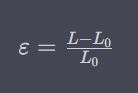
Where:
- ε represents the strain.
- L is the final length of the material after deformation.
- L0 is the original length of the material.
The strain is a dimensionless quantity, so it has no units.
Example Calculation
Let’s say you have a metal rod with an original length of 10 cm (L₀ = 10 cm), and after applying a force, it extends to a final length of 12 cm (L = 12 cm). Using the Strain Calculator, you would enter these values, and upon calculation, you would find that the strain is 12−1010=0.21012−10=0.2.
Conclusion
The Strain Calculator is a handy tool for engineers, scientists, and students working with materials and structures. It simplifies the process of calculating strain, an essential parameter in material science and mechanics.